

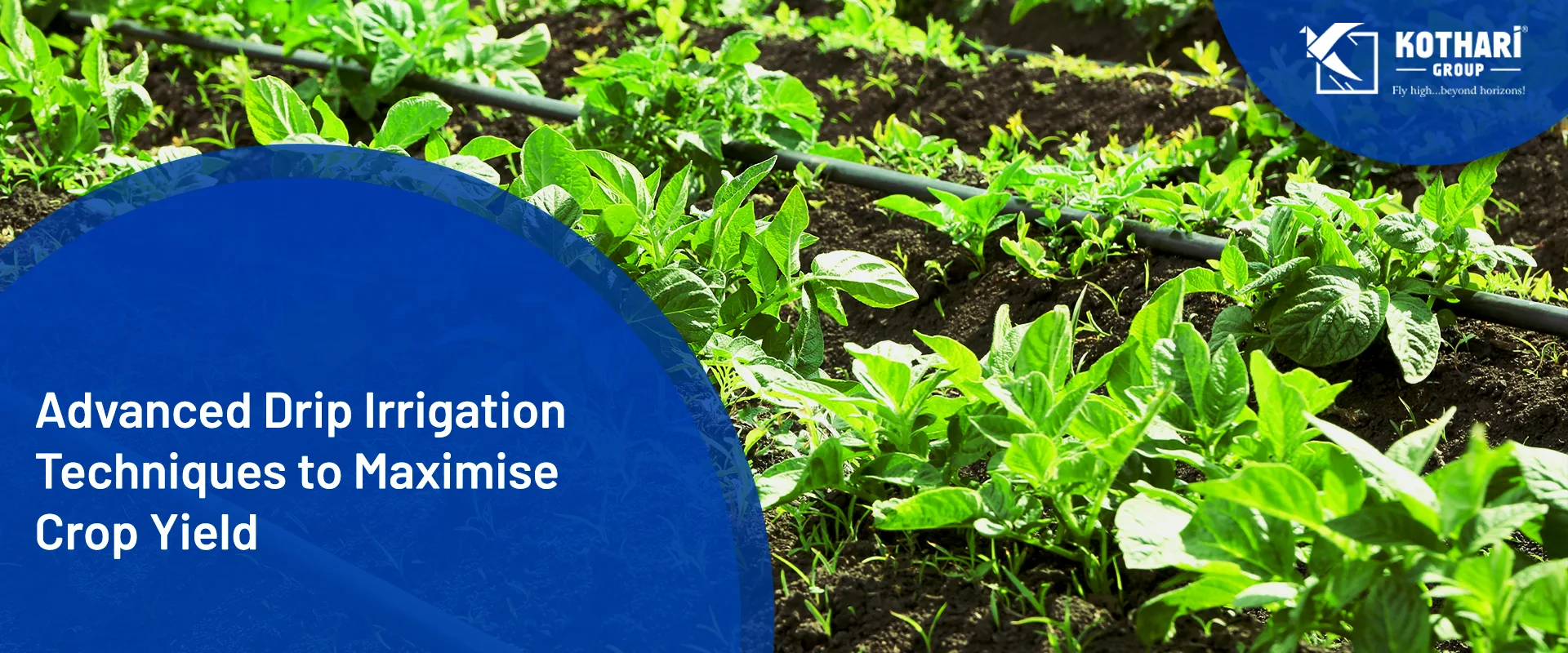
Efficient water supply across the field is a crucial factor in today’s agriculture.
When it comes to irrigation, farmers are now adopting advanced drip irrigation techniques to increase productivity while also conserving water. Hence, it helps farmers use water and maximise crop yields.
In this blog, we will learn in detail about those modern irrigation techniques and essential micro drip irrigation systems that improve crop productivity across the field.
What are the Advanced Drip Irrigation Techniques?
Drip irrigation systems are known for their precision in delivering water directly to the plant roots. Advanced techniques combine essential techniques with improved systems, automation, and technology to ensure that crops receive the right amount of water at the right time.
The key goals of these advanced drip irrigation techniques are as follows.
- Improving nutrient absorption
- Reducing water wastage
- Enhancing crop growth and quality
Therefore, by combining modern components with automation, farmers can easily manage irrigation across different crops and field conditions.
Precision Water Delivery in the Root Zone
Farmers are refining the process of how water reaches every plant. Previously, they overflooded the entire field, leading to waste. But with micro drip irrigation systems, they can easily control the flow at a granular level.
With controlled emitters, they can avoid uneven watering, which has a direct impact on fruit size and quality. Thus, water reaches the root zone evenly as it prevents both water stress and over-saturation.
This technique is useful for crops that require specific spacing, as each plant receives a uniform and measured water supply.
Scheduling Irrigation Based on Crop Needs
The next important technique is stepping away from a fixed watering routine. Not every crop requires the same amount of water every day. It is crucial to understand that over-irrigation is equally harmful as under-watering.
Hence, automated irrigation systems can simplify this process. The automated systems include timers and controllers where farmers can easily schedule irrigation cycles depending on the crop stage, soil condition, and climate.
For example, young crops require frequent and small watering cycles, whereas mature crops can grow well with less frequent irrigation.
An automatic drip irrigation system, thus, makes it easier to manage variations without the need for constant manual intervention. In this way, water delivery becomes predictable and consistent.
Using Soil Moisture Feedback
Another advanced irrigation practice is utilizing real-time data to make irrigation decisions. The regular visual inspection is fine, but now farmers are also turning to smart irrigation systems that use soil moisture sensors.
With smart irrigation systems, we at Kothari Group integrate IoT-based technology with sensors to track soil and water conditions in real time.
These sensors easily measure how much water the soil contains, so they can adjust the water flow accordingly. So, if the moisture level is sufficient, they can delay irrigation. But if the soil is drying, then the system responds immediately.
Therefore, this technique helps avoid over-stressing and over-watering of plants and ensures that crops receive an optimal growing environment.
Maintaining Uniform Pressure and Flow
Pressure variation can lead some plants to receive more water than others, while others dry out. An advanced drip irrigation system ensures maintaining consistent pressure across the system, which involves:
- Proper pipe sizing
- Pressure-regulating valves
- Regular checking of blockages and leakage
Smarter Irrigation with Integrated Fertigation
Another crucial technique that improves crop yield is fertigation. It is the process of delivering nutrients with water. Farmers can directly apply the fertilizers to the root zone in a particular amount. This helps reduce nutrient loss and improves absorption efficiency.
Hence, when combined with micro drip irrigation systems or automatic drip irrigation systems, fertigation becomes more precise, leading to better crop quality and reduced input costs.
Adapting System to Crop and Soil Conditions
One particular irrigation setup will not work the same for another farm. Different factors like crop variety, soil type, and climate have a direct impact on how much water needs to be delivered.
Here are some examples:
- Clay soils require slow application rates to prevent waterlogging
- Sandy soils require frequent irrigation due to faster drainage
- Closely-spaced crops can highly benefit from micro tube drip irrigation for uniform coverage
Thus, advanced irrigation techniques largely focus on adapting the system according to your needs rather than just following a standard approach.
Conclusion
Whether it’s using micro-drip irrigation systems for targeted watering, adopting automatic drip irrigation systems for better scheduling, or leveraging smart irrigation systems for real-time decision-making, each step moves farming towards greater efficiency.
With smart irrigation systems becoming more common, this shift is already visible on the ground. We at Kothari Group support it through IoT-enabled solutions that help farmers monitor conditions, manage water more precisely, and avoid unnecessary wastage.
Over time, this leads to more consistent hydration, healthier crops, and a farming system that is easier to manage and more dependable season after season.
FAQs
- How do micro drip irrigation systems improve crop yield?
Micro drip irrigation systems deliver water directly to the root zone in controlled, consistent amounts. This ensures that plants absorb moisture efficiently, which leads to uniform growth, leading to improved yield and quality.
- Can an automated irrigation system reduce labour costs?
Yes. Automated irrigation systems can significantly reduce labour costs. There is no need for manual monitoring and control as watering is scheduled automatically, which reduces labour dependency.
- What is the difference between an automatic drip irrigation system and a smart irrigation system?
An automatic drip irrigation system basically works on preset schedules as it comprises timers and controllers. On the other hand, smart irrigation systems use sensors and real-time data (soil moisture, weather conditions, etc. ) to adjust the irrigation process.
- Can drip irrigation be used for all types of crops?
Yes, drip irrigation can be used for a variety of crops like fruits, vegetables, sugarcane, etc. Consulting experienced providers like Kothari irrigation can help in selecting the most suitable system for your farm.