

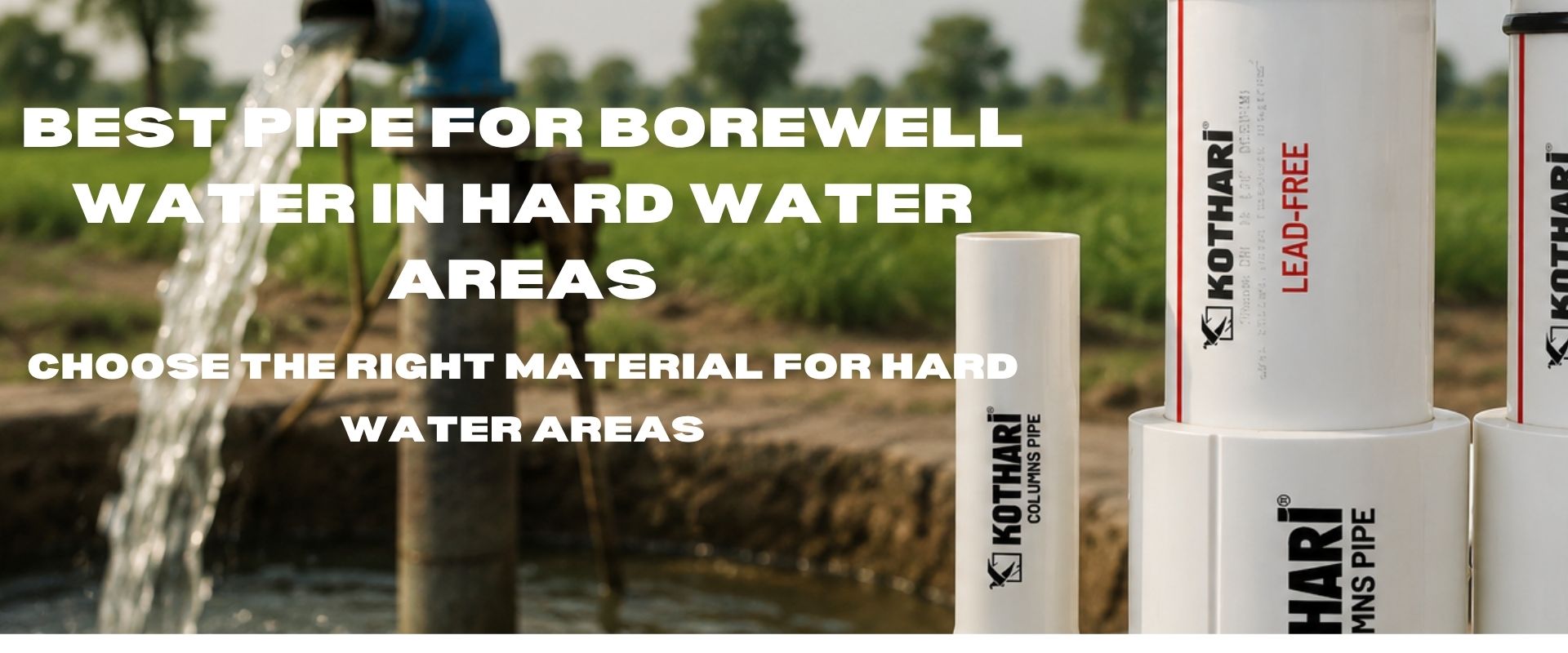
If you’re sourcing water from a borewell, choosing the best pipe for borewell water isn’t just a materials decision. It determines whether your system runs smoothly for 20 years or starts failing within 5. Groundwater in large parts of India contains high levels of dissolved calcium and magnesium. The wrong pipe material reacts poorly to this over time.
This isn’t a minor detail. Over 80% of India’s rural drinking water, and a large share of irrigation, depends on groundwater. Getting the pipe material right affects millions of systems, not just yours.
Why Hard Water Is a Bigger Problem for Borewell Pipes Than You Think
Hard water isn’t unsafe to use. But it carries dissolved minerals, mainly calcium and magnesium, and these behave very differently depending on the pipe they flow through.
The Central Ground Water Board (CGWB), under the Ministry of Jal Shakti, flags groundwater hardness and salinity as significant concerns in several regions. Parts of Rajasthan, Delhi NCR, Gujarat, and Haryana regularly see mineral concentrations exceed standard limits. If your borewell draws from one of these belts, pipe selection matters even more.
What Actually Happens Inside a Pipe Carrying Hard Water
Two separate problems show up, often at the same time:
- Scaling: dissolved minerals settle on the inner pipe wall and build up gradually, narrowing the internal diameter and reducing water flow
- Corrosion: certain pipe materials react chemically with the minerals in hard water, weakening the pipe from the inside over time
Left unaddressed, both problems compound each other. Scale builds up, flow slows, and pressure drops. Corrosion progresses until leaks or failure become inevitable.
Best Pipe for Borewell Water: Casing and Column Pipes Built for the Job
Borewell systems rely on two purpose-built components, not general-purpose plumbing pipe:
- Casing pipe: lines the borehole wall to prevent collapse and keeps soil or contaminants out of the water source
- Column pipe: connects the submersible pump to the surface and carries water upward under continuous pressure
Manufacturers typically build both from UPVC (unplasticized PVC). UPVC doesn’t react chemically with dissolved minerals the way certain other materials do. There’s no reactive surface for corrosion to attack, and its smooth bore gives scale far less to grip onto. That’s the core reason UPVC casing and column pipe consistently hold up in hard water regions.
Note that this is a different product category from general UPVC plumbing pipe used for indoor water distribution. Casing and column pipes handle underground borehole conditions specifically: constant water contact, mineral exposure, soil pressure, and structural load. That’s a different job entirely from carrying water through a building.
What About Copper or Metal Pipe?
Copper resists corrosion reasonably well in water with a neutral pH. But aggressive hard water can still cause scaling over time, and copper costs significantly more than UPVC. Metal casing pipes are far more vulnerable: their protective coatings break down faster in mineral-rich water, causing corrosion and scaling at the same time.
For borewell casing and column applications specifically, UPVC remains the most practical and proven choice across Indian conditions.
Why the Right Pipe Choice Saves More Than It Costs
It’s tempting to compare pipe materials purely on upfront price, especially on a large borewell project where every metre adds up. But that comparison misses the real cost driver: how often the pipe needs replacing.
A well-installed UPVC casing and column system resists scaling and corrosion for decades with minimal maintenance, since the material doesn’t react with the water passing through it. Every early replacement cycle, by contrast, comes with costs beyond the pipe itself:
- Labour to excavate, remove, and reinstall
- Downtime for the borewell system during replacement
- Water loss from the leaks that usually prompt the replacement in the first place
- Potential damage to the pump or motor from reduced flow before the problem is caught
Total lifespan, not just purchase price, determines whether a pipe material was the right choice.
Kothari Group Borewell Pipe Solutions
Kothari Group builds a dedicated range for borewell and groundwater extraction conditions:
- Column Pipes, built to connect the submersible pump to the surface and withstand continuous pressure
- Casing Pipes, built to protect the borehole from soil and water intrusion
If you’re setting up or upgrading a borewell system, our guide on choosing durable pipes for reliable borewell water flow walks through how column and casing pipes work together as a system.
How to Choose the Right Pipe for Your Borewell
- Get your groundwater tested for hardness, not just assumed based on region
- Choose a casing pipe designed specifically for borehole protection, not general plumbing pipe
- Choose a column pipe rated for your borewell’s depth and pump load
- Factor in total lifespan and replacement cost, not just upfront price
Signs Your Current Pipes Are Already Struggling With Hard Water
- Noticeably reduced water pressure over time
- Visible white or chalky deposits near taps, fittings, or the pump outlet
- Discoloured water, especially after the system has been idle
- More frequent fitting or joint replacements than expected
If you’re seeing two or more of these, inspect the pipe material before assuming the pump or motor is at fault.
Conclusion
The best pipe for borewell water in hard water areas isn’t the cheapest option upfront. It’s the one built for the job. Purpose-made casing and column pipe handle scaling and corrosion reliably in a way general plumbing pipe isn’t designed for. That’s exactly why they’ve become the standard for borewell systems across India.
Getting this right at the installation stage saves you the cost, disruption, and water loss of an early pipe failure down the line.
Setting up or upgrading a borewell system in a hard water area? Speak with our team for guidance on the right pipe combination for your groundwater conditions, or explore our borewell casing and column pipe range built for exactly this.
FAQs
1. What is the best pipe for borewell water in hard water areas?
Purpose-built casing and column pipe, typically made from UPVC, is the standard choice for borewell systems in hard water areas. The material resists both scaling and corrosion.
2. Can hard water damage UPVC pipes?
No. UPVC doesn’t react chemically with dissolved minerals the way some other materials do, so it resists both scaling and corrosion over the long term.
3. What’s the difference between casing pipe and column pipe?
Casing pipe lines the borehole wall to prevent collapse and keep contaminants out. Column pipe connects the submersible pump to the surface and carries water upward under continuous pressure.
4. Can I use regular UPVC plumbing pipe for a borewell?
Not ideally. General plumbing pipe handles indoor water distribution, not the underground pressure, soil contact, and structural demands of a borehole. Purpose-built casing and column pipe handle that job specifically.
5. How do I know if my area has hard water?
Groundwater testing is the most reliable way to confirm hardness levels. Parts of Rajasthan, Delhi NCR, Gujarat, and Haryana show higher mineral concentrations, based on CGWB monitoring data.
6. Is copper a good alternative to UPVC for borewell water?
Copper resists corrosion reasonably well in neutral pH water but can still scale in aggressive hard water conditions. It also costs significantly more than UPVC for the same application.