

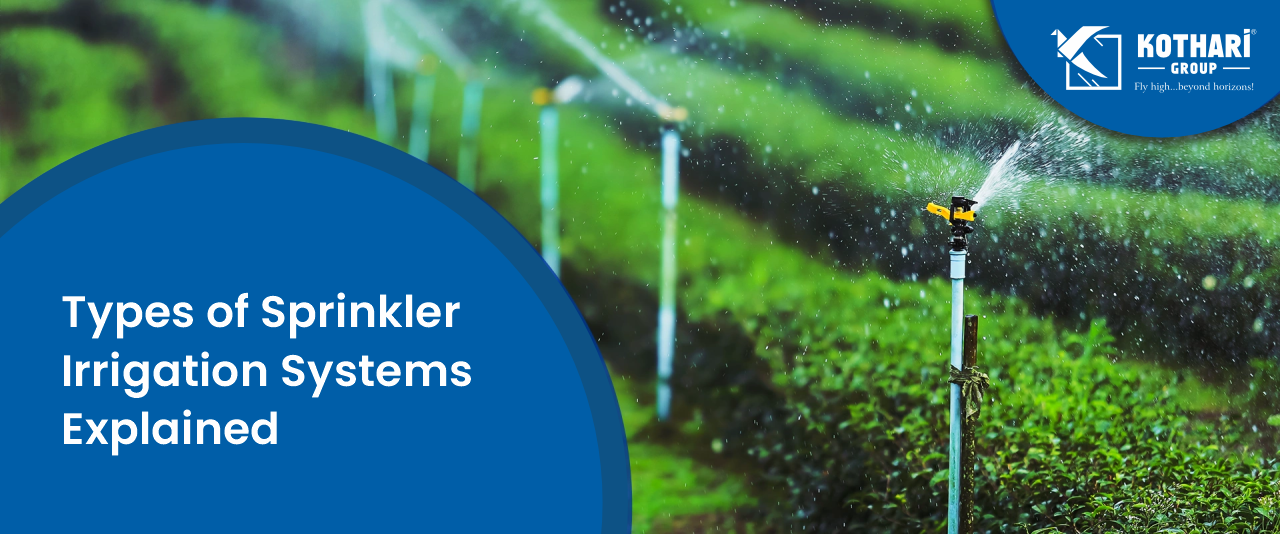
Agriculture across India heavily depends on water. As water availability is still uneven in many regions, ensuring proper management is a critical decision farmers can make. The increasing irrigation costs, irregular rainfall, and increasing pressure to produce more crops are some essential factors leading farmers to opt for an efficient agricultural irrigation system.
Sprinkler irrigation systems are now emerging as a reliable step to overcome these challenges. Thus, farmers are investing in systems that reduce water waste, promote steady crop growth, and lower the manual effort in daily tasks.
In this blog, we will discuss different types of sprinkler systems and how they are beneficial for different types of crops in detail.
Why Farmers are Opting for Sprinkler Irrigation
The traditional method of flood irrigation is not very efficient. In this process, the water is unevenly distributed across the farm. Due to this, it can wash away the topsoil, drain nutrients, and also lead to significant water loss.
To solve this issue, sprinkler irrigation systems are considered to be an efficient solution. In this process, the water travels through pipes and is sprayed through nozzles across the field. This step ensures even distribution of water.
The main reasons farmers choose sprinkler irrigation:
- Water consumption is lower compared to flood methods
- The systems work well on uneven or sloped land
- Large areas can be covered without significant extra effort
- Soil erosion is reduced
- Crop growth tends to be more consistent across the field
These benefits are why manufacturers like Kothari Group continue to focus on developing efficient metal sprinkler systems and irrigation solutions…
Different Sprinkler Systems Used on Farms Today
Every farm has different requirements. Field size, soil type, water requirements, and crop nutrition vary from one place to another. That’s the reason proper distribution of water across the field becomes very important. These are the different types of sprinkler systems that can be installed for irrigation.
Semi-Permanent and Permanent Sprinkler Systems
This type of irrigation sprinkler includes a fixed main pipeline, while the sprinklers themselves may either stay fixed or be moved as needed. It is commonly installed in areas where crops require consistent, year-round watering, making it a dependable choice for long-term use.
Best suited for:
Leafy vegetables, Onion, Garlic, soybean, Bengal gram, potato, green peas etc.
Benefits:
- Reduced labour effort
- Reliable and consistent irrigation schedule
- Long-term durability
- Improved crop health and yield
These sprinkler irrigation systems are ideal for farms that need dependable irrigation season after season.
Raingun Irrigation Systems
Rainguns are among the most popular irrigation sprinklers from Kothari Irrigation, designed for large farms.
They are efficient for farms that need wide coverage in a lesser time.
The raingun irrigation system is further supported by HDPE sprinkler pipes and heavy-duty accessories to efficiently work even under high pressure.
Best suited for:
- Wheat and fodder crops
- Sugarcane and maize
- Large agricultural fields
Benefits:
- Covers large areas quickly
- Best for water-intensive crops
- Reduces irrigation time significantly
- Minimises labour and operational effort
Micro Sprinkler Irrigation System
Water pressure is also important when watering the crops. It is important to manage the water pressure when watering the field. High water pressure can damage young plants and affect delicate roots. Micro sprinkler systems solve this problem by releasing small droplets of water. That’s why it is one of the best options for irrigation for small plants in large volumes.
Best suited for:
- Nurseries and greenhouses
- Vegetables and fruits
- Floriculture and greenhouses
Benefits:
- Maintains steady and balanced soil moisture
- Gentle application avoids crop and soil damage
- Improves yield quality
- Uses less water and energy compared to standard sprinkler systems
Portable Sprinkler Irrigation System
For farmers working across multiple plots, flexibility is crucial for them. Portable sprinkler irrigation systems can be moved easily and set up anywhere, anytime, wherever you need them.
Best suited for
- Vegetables, pulses, and oilseeds
- Small grain crops
- Small to medium farms
Benefits
- Low initial investment irrigation system
- Easy relocation across fields
- Suitable for uneven or fragmented land
- Reduces labor compared to manual watering
Choosing the Right Sprinkler Irrigation System for Your Farm
Every farm is different, and every crop has different behavior and water needs. Also, soil and climatic conditions can vary depending on how water is delivered across the farm. That’s why choosing the right partner for an irrigation system is a critical decision for every farmer.
A good irrigation system helps farmers grow more while using less water, which is a win for both productivity and sustainability.
Investing in a well-planned sprinkler irrigation system can help farmers:
- Reduce soil erosion and nutrient runoff
- Lower labor and energy costs over time
- Use water more efficiently without affecting crop growth
- Support long-term sustainable farming practices
- Maintain steady crop development across seasons
Conclusion
Ensuring water efficiency in agriculture is not just a future concern, but a current issue. Having the right sprinkler irrigation system in place, along with reliable sprinkler connectors and accessories, farmers can easily deliver water accurately.
. It reduces waste and also improves overall crop output simultaneously.
With a wide range of reliable irrigation sprinkler systems, Kothari Irrigation continues to support farmers in adopting efficient irrigation practices that help farms grow stronger season after season.
Frequently Asked Questions
What is the difference between a micro sprinkler and a regular sprinkler?
Amicro sprinkler releases water in very fine droplets at low pressure. This feature makes it the best option for nurseries, fruits, and delicate crops. Along with that, regular irrigation sprinklers work better for open field crops and handle higher water volumes.
How do I choose the right irrigation system for farms?
To choose the right irrigation system for any field, you need to consider factors such as crop type, field size, soil condition, and water availability. Manufacturers like Kothari Group provide essential guidance and irrigation solutions for every farm requirement.
Is sprinkler irrigation difficult to maintain?
With proper installation and good quality components, maintenance is straightforward. Routine checks of sprinkler heads and pipes, along with periodic cleaning, are generally all that is required to keep the system running well.
Which crops benefit most from sprinkler irrigation?
Sprinkler systems are considered to work best for a wide range of crops like vegetables, grains, oilseeds, fruits, plantations, etc.