

Traditional irrigation systems, such as sprinklers and conventional drip pipes, are popular options used by Indian farmers. These methods are common but often lead to water waste and higher energy use, making them less compatible with sustainability goals.
The traditional pipes spray water unevenly across the field, leaving some areas dry and some overwatered. That’s exactly what agricultural drip irrigation systems are designed to address.
In this blog, we will understand how drip irrigation works and how it can help you save water.
How Do Drip Irrigation Systems Work?
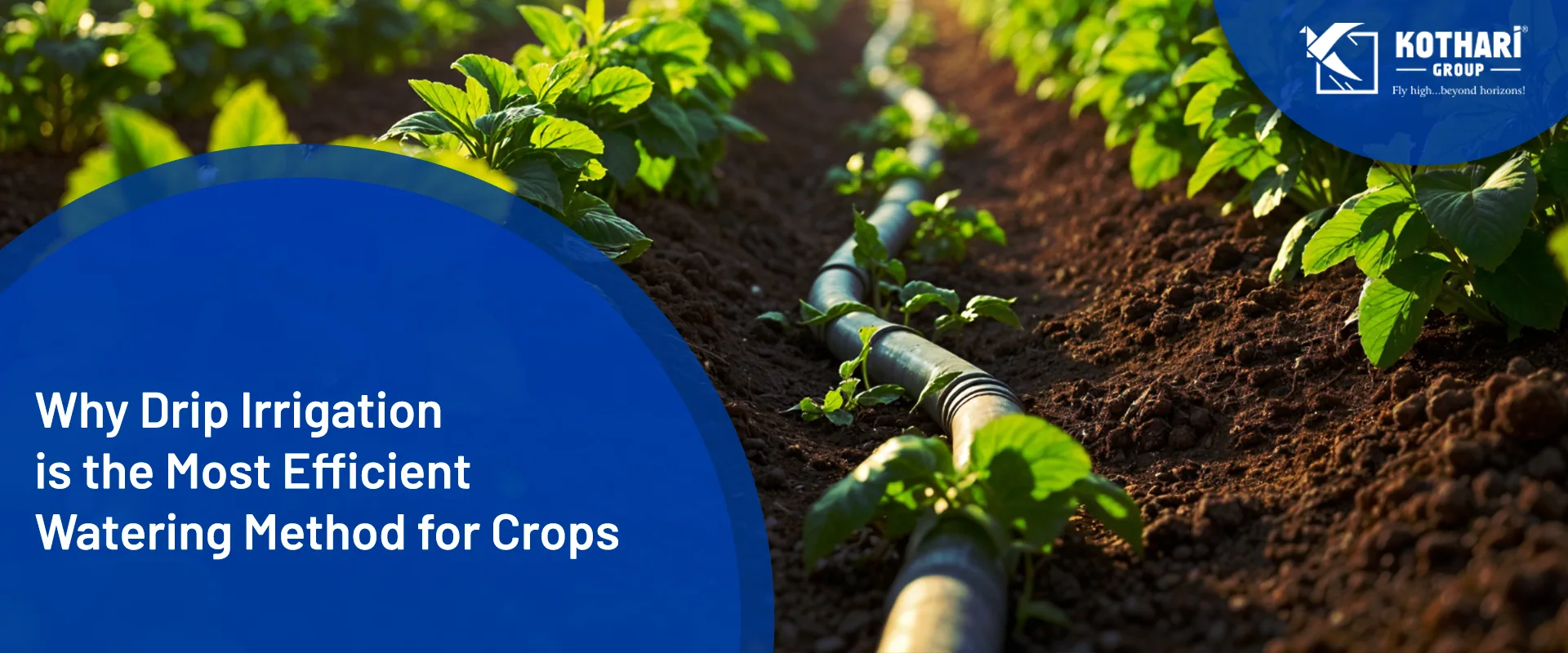
A network of pipes, valves, and emitters makes up a drip watering system, which precisely delivers water to plant roots. Water, therefore, passes through the tiny tubes and drips straight to the ground rather than flooding an entire field.
With controlled flow directly to the roots, plants absorb moisture efficiently, preventing unnecessary waste.
Importantly, a variety of crops, including fruits, vegetables, and plantation crops, can be grown with an agricultural drip irrigation system. The system can be further modified to accommodate various farm sizes and soil types.
5 Reasons Why Drip Irrigation Is the Most Efficient Watering Method
1. Significant Water Savings
When it comes to utilising every drop of water efficiently, installing drip irrigation systems is the best choice. It’s because drip systems release water slowly and directly where needed. In this way, you can improve post-management in agriculture, especially in regions where water availability is limited.
2. Increased Crop Yield and Growth
For crops to grow healthily, a steady supply of water is necessary. Uneven watering further hinders root development and lowers productivity in plants.
By installing a drip irrigation system, soil moisture in the root zone is maintained at a consistent level. This supports better nutrient absorption, promoting healthier plant growth.
Using agricultural drip irrigation systems also frequently results in higher yields and better crop quality for farmers.
3. Reduced Weed Growth
In traditional irrigation methods, the water supply is managed to ensure it is evenly distributed across the entire field. In this way, it encourages the weeds to grow between crops.
Drip irrigation delivers water only to the base of the plant. The surrounding soil remains relatively dry, making it harder for weeds to develop.
This reduces competition for nutrients and allows crops to grow more efficiently.
4. Lower Labour and Operational Costs
Keeping a traditional drip irrigation system running smoothly is exhausting. Farmers often have to check and adjust the flow every now and then, constantly, to ensure that every part of the field gets the appropriate amount of water.
Kothari’s automated agricultural irrigation system eliminates the need for manual monitoring. The use of IoT technology to deliver water to exactly where it’s needed helps keep crops healthy. Along with that, it reduces the risk of diseases and nutrient loss in plant growth.
Automated valves and timers enable you to schedule watering across the whole farm without the need to stand over it all day. As a result, you can ensure consistent watering with less manual work and lower labour costs.
5. Supports Fertigation and Nutrient Efficiency
Drip irrigation systems play a major role in supporting fertigation, where fertilisers are delivered through the irrigation network.
So, instead of spreading fertiliser across the entire field, farmers can apply nutrients directly to the root zone through a drip irrigation system. In this way, they ensure that the plants receive nutrients efficiently while reducing fertiliser wastage.
As a result, enhanced nutrient delivery contributes to stronger plant growth and improved crop productivity.
Read Also: Why Automated Irrigation Systems Are a Must in India
Choosing the Right Drip Irrigation System
Durable pipes, emitters, and connectors, manufactured by a reliable drip irrigation system manufacturer in India, such as Kothari Pipes, are designed for real-world farm conditions. Hence, they ensure robust performance across a wide variety of crops.
Working with a reliable drip irrigation system manufacturer in India also ensures that farmers receive well-designed systems suited to their crops and the field conditions.
By combining durability with thoughtful design, these systems also help farmers manage water sustainably while maintaining strong yields.
FAQs
- How much water can drip irrigation save?
Compared with traditional irrigation methods, drip irrigation can reduce water waste by 30-60% by delivering water more efficiently.
- Is drip irrigation suitable for all farms?
Drip irrigation systems are scalable and can be installed on both small farms and large agricultural fields.
- How long can drip irrigation last?
Drip irrigation systems with proper installation and maintenance can operate efficiently for several years.
- Can we use drip irrigation in all types of soil?
Drip irrigation systems can be designed for loamy, sandy, or clay soils. Farmers can adjust emitter spacing and water flow based on soil type to ensure proper moisture distribution.
5. Can we automate the drip irrigation system in our farm?
Yes, you can easily automate drip irrigation systems with Kothari’s IoT-enabled systems, such as sensors, timers, and automated controllers, to ensure optimized use of resources and healthy crop growth.