

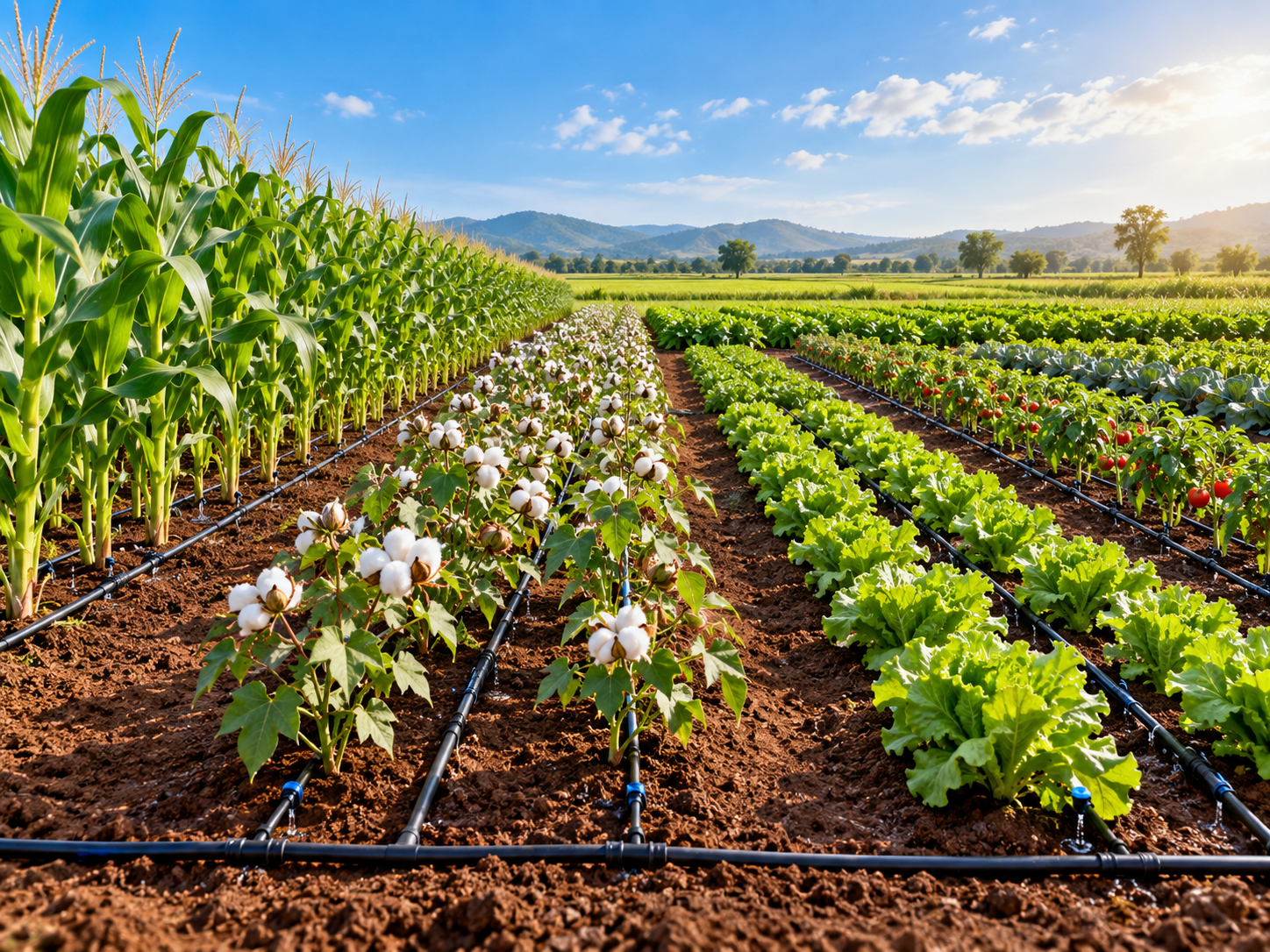
Irrigation for Other Field Crops
Plan field-crop irrigation around water availability, field size and distribution requirements with practical piping for farm-level water movement.
Irrigation for Field Crops Overview
Crops like cotton, soybeans, pulses, groundnuts, and cereals usually cover a lot of ground, and getting water where it's needed can be tricky. You want an irrigation system that gets water from the source to every corner of the field, but you also don't want something that's a pain to set up, use, or move around.
Depending on the irrigation method, the network may include a water source, pump, main conveyance line, distribution lines and field-level irrigation equipment. In open fields, the piping arrangement also needs to suit the crop layout, field distance and irrigation schedule.
For some farms, the priority is moving water efficiently from the source to different field sections. In others, the requirement is to connect the distribution network to drip or sprinkler equipment. The piping selected should therefore match the way the field is irrigated, the distance involved, available water flow and the practical conditions under which the system will be installed and maintained.
Where Field Crop Irrigation Is Used
Irrigation piping for field crops is used across farms where water has to be distributed over open cultivation areas and the irrigation network needs to suit seasonal cropping patterns.
Cotton and Fibre Crops
Water can be conveyed from the source to field sections and connected to the selected irrigation arrangement.
Pulses and Oilseeds
Piping can support irrigation across open fields where crop areas and irrigation sections may change between seasons.
Cereals and Other Field Crops
Water conveyance lines can connect the farm water source with different sections of the cultivated area.
Seasonal Cropping Fields
The system can be planned around changing crop layouts and irrigation requirements from one cultivation cycle to another.
Large Open Fields
Longer distances between the water source and crop area may require dedicated conveyance and distribution arrangements.
Key Requirements for Field Crop Irrigation
The right piping arrangement depends largely on how water needs to move through the farm. Before selecting a product, the source location, field size and irrigation method should be understood.
Recommended Kothari Products
For other field crops, the piping requirement can vary between water conveyance and field-level irrigation distribution. Kothari's LD Krishi Pipe and Polytube address these different stages of farm irrigation.

LD Krishi Pipe (Lay Flat Tubes)
LD Krishi Pipe is a lay-flat tube designed for farm water conveyance. It can be considered where water needs to be moved between the source, field sections and irrigation points through a practical surface-laid arrangement.

Polytube
Polytube is used at the distribution side of irrigation systems where water needs to be carried towards field-level irrigation components. Kothari lists its Polytube for online drip irrigation in open-field installations, connections between submain and inline systems, and installation of micro and mini sprinklers. Available sizes listed by Kothari include 12, 16, 20, 25 and 32 mm.
| Application Requirement | Recommended Kothari Product | Role in the System |
|---|---|---|
| Farm water conveyance | LD Krishi Pipe | Moves water between source and field sections |
| Field-level distribution | Polytube | Carries water towards irrigation components |
| Drip irrigation connections | Polytube | Connects distribution network with drip components |
| Micro / mini sprinkler installation | Polytube | Provides field-level connection to irrigation equipment |
Planning Irrigation for Your Field Crops?
Share your field size, water source and irrigation method with the Kothari Irrigation team to discuss the suitable piping arrangement.
Discuss Your Requirement