

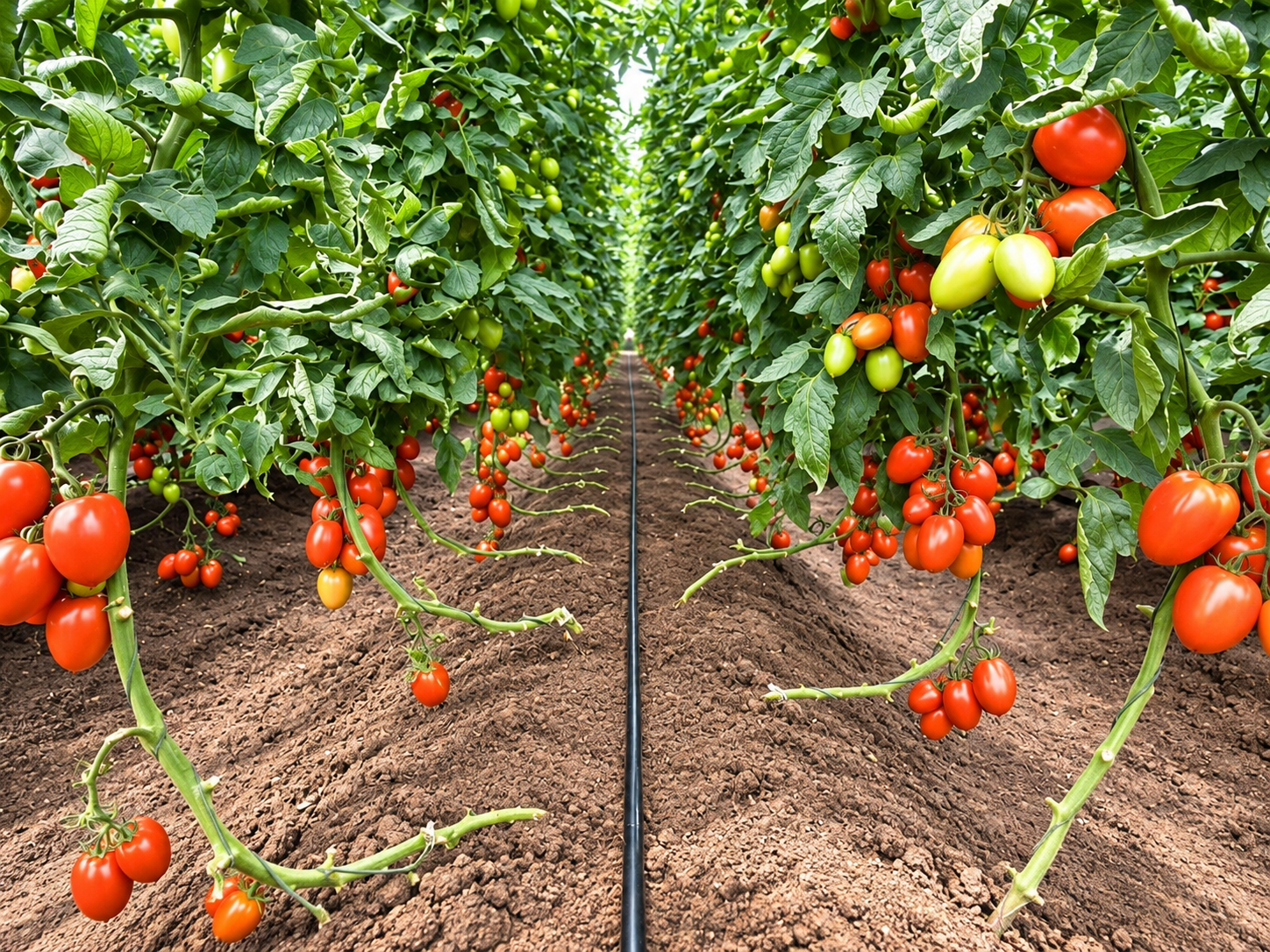
Vegetable Irrigation Systems
Plan irrigation around crop rows, field layout and water availability with a drip-based system suited to vegetable cultivation.
Understanding Vegetable Irrigation Systems
Vegetable crops often require irrigation to be organised around closely spaced crop rows and changing field requirements. In open-field cultivation, water has to move from the source to different sections of the farm and then reach the crop through a properly planned distribution network.
A vegetable irrigation system typically combines the water source, filtration, main and distribution pipelines, field connections and dripline. The pipeline network carries water towards the growing area, while the dripline provides the final distribution along the crop rows.
Field size, crop arrangement, water availability, flow, pressure and filtration requirements all influence the irrigation layout. Shorter crop cycles and multiple cultivation areas can also make practical operation and maintenance important considerations.
The irrigation network therefore needs to be planned as a complete system. The dripline, connections and distribution lines should suit the field layout and allow the farmer to manage different sections without making routine maintenance difficult.
Where Vegetable Irrigation Systems Are Used
Vegetable irrigation systems are used across different types of vegetable cultivation where water needs to be distributed through planned field rows. The exact arrangement depends on the crop, field size, water source and irrigation method.
Open-Field Vegetable Cultivation
A dripline can be arranged along vegetable crop rows, with distribution lines supplying different sections of the field.
Commercial Vegetable Farms
Larger farms can divide the growing area into irrigation sections based on field layout and available water supply.
Seasonal Vegetable Crops
For crops grown over shorter cultivation cycles, the irrigation system needs to be practical to install, operate and maintain throughout the growing period.
Multiple Vegetable Blocks
Where different vegetables are cultivated in separate areas, the distribution network can be planned around individual field sections and their irrigation requirements.
Protected Cultivation
Where drip irrigation is used in protected growing environments, the distribution network can be planned according to the bed and crop layout.
Key Requirements for Vegetable Irrigation
Vegetable irrigation needs to be planned according to the crop layout and the physical arrangement of the field. The dripline should form part of a properly designed water-distribution network rather than being considered separately.
Recommended Products
For vegetable cultivation, Thin Wall Dripline K-Slim and Thin Wall Dripline K-Slim Ultra are relevant at the field-distribution stage of the irrigation system. They can be considered as part of a wider network consisting of the water source, filtration, mainline, distribution lines and field connections.

Thin Wall Dripline K-Slim
Thin Wall Dripline K-Slim is intended for use as part of a drip irrigation arrangement where water needs to be distributed along vegetable crop rows. It forms the final field-level section of the system after water has been carried through the main and distribution network.

Thin Wall Dripline K-Slim Ultra
Thin Wall Dripline K-Slim Ultra is another thin-wall dripline option that can be considered for vegetable irrigation applications. It sits at the field-distribution stage and can be incorporated into a layout where a dripline follows the planned vegetable rows or beds.
| Application Requirement | Recommended Kothari Product | Role in the System |
|---|---|---|
| Vegetable row irrigation | Thin Wall Dripline K-Slim | Field-level drip distribution |
| Vegetable bed irrigation | Thin Wall Dripline K-Slim Ultra | Field-level drip distribution |
| Drip-based vegetable irrigation | K-Slim / K-Slim Ultra | Final water-distribution stage |
Planning a Vegetable Irrigation System?
Share your crop layout, field size and water-source details with the Kothari team to discuss the appropriate dripline arrangement.
Discuss Your Requirement