

Industrial Water Supply
Piping systems designed around the flow, pressure, route and operating conditions of industrial water networks.
Industrial Water Supply Overview
Industrial facilities often need to move water across considerable distances from a source or storage point to production areas, utility sections, treatment facilities and other points of use. The piping network has to handle the required flow while fitting around plant layouts, equipment and site conditions.
Unlike a simple building water line, an industrial water supply system may include long pipeline runs, underground sections, above-ground routes, multiple branches and different operating conditions across the network. Pipe selection therefore depends on factors such as water quality, flow, pressure, pipeline length, installation environment and the purpose for which the water is being supplied.
The right piping system should be selected as part of the overall hydraulic and project design. Depending on the application and operating conditions, HDPE pipes can be considered for suitable sections of an industrial water supply network.
Where Industrial Water Supply Is Used
Industrial water supply systems are used wherever a facility needs to transfer and distribute water between its source, storage infrastructure, utilities and operating areas.
Manufacturing facilities
Water can be distributed to production-support areas, utilities and other designated points within the plant.
Industrial plants and factories
Pipeline networks may connect storage tanks, water-treatment systems and different sections of the facility.
Process and utility water networks
Water can be transferred between treatment, storage and utility areas according to the plant's process design.
Industrial estates and large facilities
Longer pipelines may distribute water from a common source or storage facility to different operational zones.
Infrastructure and utility projects
Water transmission and distribution pipelines can connect supply points with remote or multiple points of use.
The actual piping arrangement depends on the water source, required flow, pressure, pipeline route and operating conditions of the project.
Key Requirements for Industrial Water Supply
Industrial water supply systems need to be planned as a complete network rather than as individual pipeline sections. The design should account for water quality, flow requirements, operating pressure, installation conditions, and the overall pipeline route.
Recommended Kothari Products
For industrial water supply, HDPE Pipes can serve different requirements within a water-transfer or distribution network. The final selection should be based on the projects hydraulic design and operating conditions.

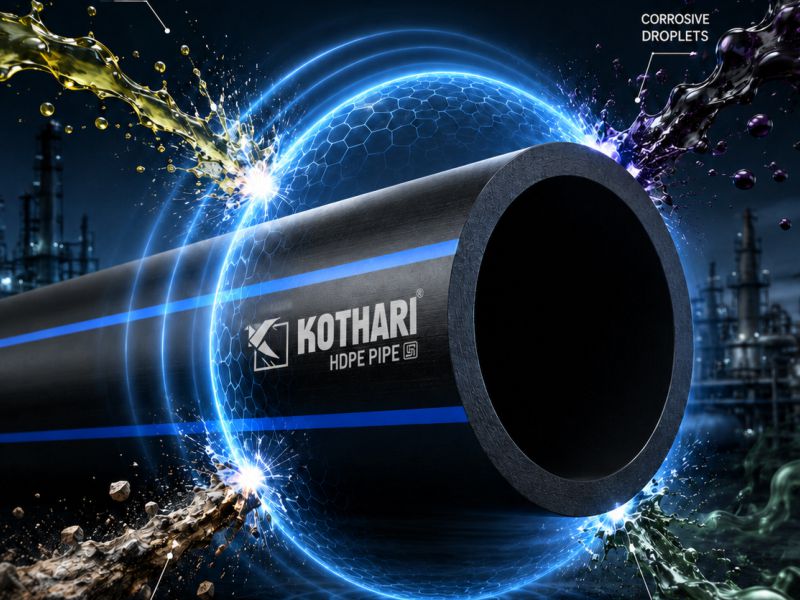
Kothari HDPE Pipes
HDPE Pipes can be considered for industrial water pipelines where the project requires an appropriate polyethylene piping system for the intended operating and installation conditions.
Product Selection at a Glance
| Application Requirement | Recommended Kothari Product | Role in the System |
|---|---|---|
| Transfer water from the source across the farm | HDPE Pipe | Main or distribution water-transfer pipeline |
| Rising and distributing lines | Self Fit PVC Pipe | Pressure water-supply and distribution line |
| Main and sub-main irrigation lines | Self Fit PVC Pipe | Carries water towards drip or sprinkler networks |
| Changes in direction or pipeline branches | Agri PVC Moulded Fittings | Connects, redirects and branches the pipeline |
| Different pipe sizes need to be connected | Agri PVC Moulded Fittings | Reducers/adapters provide the required connection |
Planning an Industrial Water Supply System?
The right pipe depends on more than the required diameter. Flow, pressure, water characteristics and installation conditions all influence the selection. Share your industrial water supply requirement with the Kothari team to discuss the appropriate piping options for your project.
Discuss Your Requirement