

One Planet. One Water. One Responsibility.
When astronauts look at Earth from space, they see a magnificent blue planet. Nearly 71% of the Earth’s surface is covered with water, which gives the impression that water is abundant everywhere. But that impression hides an important truth about micro irrigation for sustainable agriculture in India, and why it matters more than most people realise.
Water Covers the Earth, But Freshwater Is Surprisingly Rare
Earth contains approximately 1.386 billion cubic kilometres of water. Of that enormous quantity:
- 96.5% is in oceans and too salty for drinking or agriculture
- Only about 2.5% is freshwater
- Of that freshwater, nearly 69% is locked in glaciers and polar ice caps
- About 30% lies underground as groundwater
- Less than 1% is available in rivers, lakes, wetlands, soil moisture, and the atmosphere, the very water that supports agriculture, industries, ecosystems, and human life
If all the water on Earth were 10,000 litres:
| Water Source | Water Available |
| Oceans (Salt Water) | 9,654 litres |
| Ice Caps & Glaciers | 174 litres |
| Fresh Groundwater | 76 litres |
| Rivers, Lakes, Soil, Atmosphere & Living Organisms | Less than 3 litres |
Every meal we eat, every glass of drinking water, every forest, and every industry depends on less than three litres out of every 10,000 litres of water on Earth. Water is not an unlimited resource. It’s one of the world’s most precious natural assets.
India’s Water Challenge
India is home to about 18% of the global population, yet it holds only around 4% of the world’s renewable freshwater resources. Agriculture consumes nearly 80-85% of India’s freshwater withdrawals.
At the same time, India faces serious pressure on every front:
- Declining groundwater levels
- Irregular and unpredictable rainfall
- Increasing droughts and floods due to climate change
- Rising demand for food, fruits, vegetables, and fibre
- Rapid urbanisation and industrial water demand
The real question isn’t where India will find more water. It’s how the country produces more food with the same, or even less, water than it has today.
Why Traditional Flood Irrigation Is No Longer Enough
For generations, fields have been irrigated using flood irrigation. It’s simple to practice, but much of the water never reaches the crop. Large quantities are lost through:
- Evaporation
- Surface runoff
- Deep percolation below the root zone
- Uneven water distribution
Along with water, valuable plant nutrients are lost too, reducing fertiliser efficiency and increasing cultivation costs. In an era where water is becoming scarce, these losses are no longer sustainable.
What Is Micro Irrigation and How Does It Work?
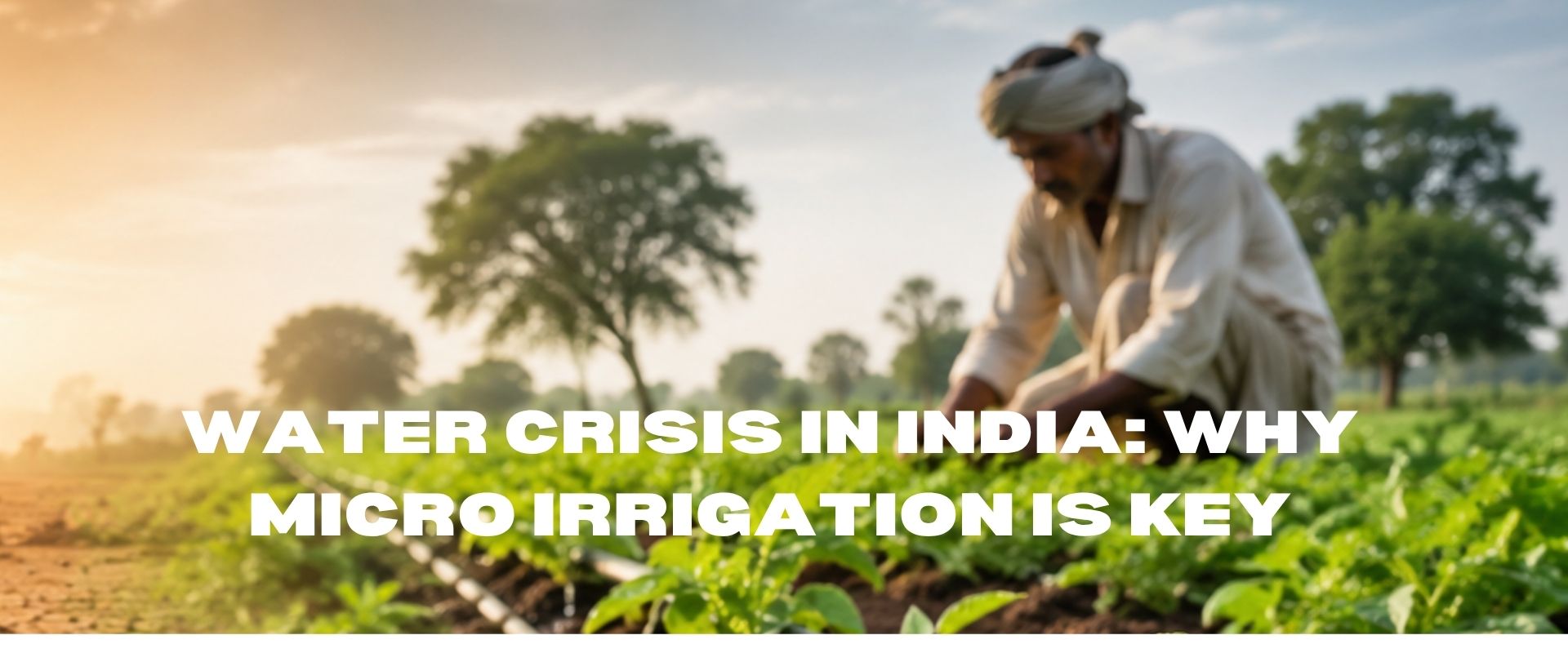
Micro irrigation is a method of delivering water directly to a plant’s root zone in small, controlled amounts through drip lines, sprinklers, or micro-sprayers, rather than flooding an entire field. It’s built on a simple principle: give each plant exactly what it needs, exactly where it needs it.
The Government of India has recognised micro irrigation as central to the country’s water security. Under the Per Drop More Crop component of the Pradhan Mantri Krishi Sinchayee Yojana (PMKSY), farmers receive financial assistance to adopt drip and sprinkler irrigation, with higher subsidies for small and marginal landholders. The scheme’s objective mirrors exactly what this article is about: using every available drop more efficiently, rather than searching for new water sources.
Drip Irrigation: Every Drop Reaches the Root
Nature never wastes water. Every crop needs a specific quantity at different stages of growth, and drip irrigation follows that same principle. Water is supplied slowly, uniformly, and directly to the root zone, exactly where it’s required.
Scientific drip irrigation helps farmers:
- Save substantial amounts of irrigation water
- Improve fertiliser efficiency through fertigation
- Reduce weed growth
- Lower energy and labour costs
- Increase crop productivity
- Improve fruit and vegetable quality
- Enhance overall profitability
Every drop of water is transformed into healthy plant growth rather than lost.
Kothari Group: Complete Water Management Solutions
Water management begins long before irrigation starts. It begins with safely transporting water, distributing it efficiently, and applying it precisely where crops need it.
Kothari Group’s product ecosystem includes:
- PVC, HDPE, and PE pipe systems
- Plumbing pipe systems
- Agricultural water conveyance systems
- Drip Irrigation Systems
- Sprinkler Irrigation Systems
- Fertigation solutions
- Filtration systems
- Automation and intelligent irrigation control technologies
Each solution is engineered to improve water-use efficiency while meeting the diverse needs of Indian agriculture, industry, infrastructure, and rural development.
Designed for Indian Field Conditions
Every farm is different. Soil type, crop, climate, water quality, topography, and farmer practices vary across India, so irrigation technology has to adapt to local conditions rather than follow a one-size-fits-all approach.
Kothari Group develops solutions specifically suited to Indian agriculture by combining scientific irrigation design, precision engineering, advanced manufacturing, automation technologies, agronomic expertise, field demonstrations, and farmer training. The objective is simple: deliver the right quantity of water to every plant, at the right time, with minimum wastage and maximum productivity.
Why Knowledge Matters as Much as Technology
Modern irrigation systems only become truly effective when supported by scientific crop management. That’s why Kothari Group treats farmer education as seriously as manufacturing world-class products.
Our agronomists, irrigation engineers, and trained field teams work directly with farmers on:
- Crop water requirements
- Irrigation scheduling
- Fertigation management
- Water quality management
- System maintenance
- Precision farming practices
- Sustainable agriculture
We consider ourselves “Water Servants”: professionals committed to helping farmers use every drop of water wisely. If you’re troubleshooting an existing system, our guide on common drip irrigation problems and how to fix them covers the issues farmers run into most often.
Transforming Every Drop into Food Security
Water alone cannot feed the world. Scientific water management can. Every drop delivered with precision strengthens roots, nurtures healthier plants, increases yields, and produces nutritious food while conserving precious resources.
At Kothari Group, we’re committed to transforming water into sustainable agricultural prosperity through advanced piping systems, micro-irrigation, automation, and farmer-centric knowledge. Together with India’s farming community, we work to maximise every drop, protect groundwater, strengthen rural livelihoods, and secure food for future generations.
Conclusion
Earth contains 1.386 billion cubic kilometres of water, yet only a tiny fraction is available to sustain human life and agriculture. India, with one of the world’s largest populations and limited freshwater resources, carries an even greater responsibility to manage water wisely.
At Kothari Group, we embrace that responsibility by delivering complete water management solutions, from PVC, HDPE, PE, and plumbing piping systems to advanced sprinkler, drip irrigation, automation, fertigation, and farmer education.
Save every drop. Deliver every drop. Nourish every plant. Feed every family.
Because every drop saved today becomes tomorrow’s harvest, strengthens our farmers, and builds a more water-secure and prosperous India.
Want to explore how micro irrigation could work for your farm or project? Get in touch with our irrigation experts or explore our drip irrigation systems built specifically for Indian field conditions.
FAQs
1. What is micro irrigation?
Micro irrigation delivers water directly to a plant’s root zone in small, controlled amounts through drip lines, sprinklers, or micro-sprayers, instead of flooding an entire field.
2. How much water can drip irrigation save compared to flood irrigation?
Drip irrigation significantly reduces losses from evaporation, runoff, and deep percolation compared to flood irrigation, though exact savings vary by crop, soil, and system design.
3. Does the government support farmers adopting micro irrigation?
Yes. Under the Per Drop More Crop component of PMKSY, the government provides financial assistance for drip and sprinkler irrigation adoption, with additional support for small and marginal farmers.
4. Is micro irrigation suitable for all types of farms in India?
Micro irrigation systems can be adapted to different soil types, crops, and terrains, though the right configuration depends on local field conditions and is best assessed with expert guidance.
5. What does Kothari Group offer for farm water management?
Kothari Group provides drip and sprinkler irrigation systems, fertigation and filtration solutions, automation technologies, and agricultural piping systems, along with farmer training and technical support.