

Have you ever seen a leaking pipe create black mould on building walls? Well, the leakage gives a bad impression to your guests. This mishap can be avoided if you use leakage-proof pipes; hence, having good pipes and plumbing systems is crucial.
Let’s break down usage and advantages to help you choose the best pipes for plumbing in India.
Top 3 Plumbing Pipes for Residential and Commercial Buildings
What makes the pipes suitable for residential and commercial use? The pipes should be easy to install and durable for long-lasting performance. They should also use lightweight materials that are safe for water to flow through, such as PVC, CPVC, and Copper. Additionally, it should be leak-proof.
1. CPVC Pipe
Known for excellent resistance to heat and corrosion, CPVC (Chlorinated Polyvinyl Chloride) pipes are commonly used for hot water systems. They do not corrode even in harsh water conditions, ensuring long-term reliability and minimising maintenance costs. This pipe is suitable for both residential and commercial buildings.
Residential use:
If you return home tired after a long working day, you get into the shower, and the hot water instantly relieves your stress. Durable CPVC pipes supply this hot water, typically installed in bathrooms and kitchens.
Commercial use:
For instance, you are staying in a hotel in chilly winter and instantly get hot water, which is made possible due to CPVC pipes. It is common in commercial spaces such as hotels, office buildings, and hospitals, on a large scale, for hot water systems. These CPVC pipes and fittings for commercial plumbing often handle high demand for hot water in restrooms and kitchens.
Advantages:
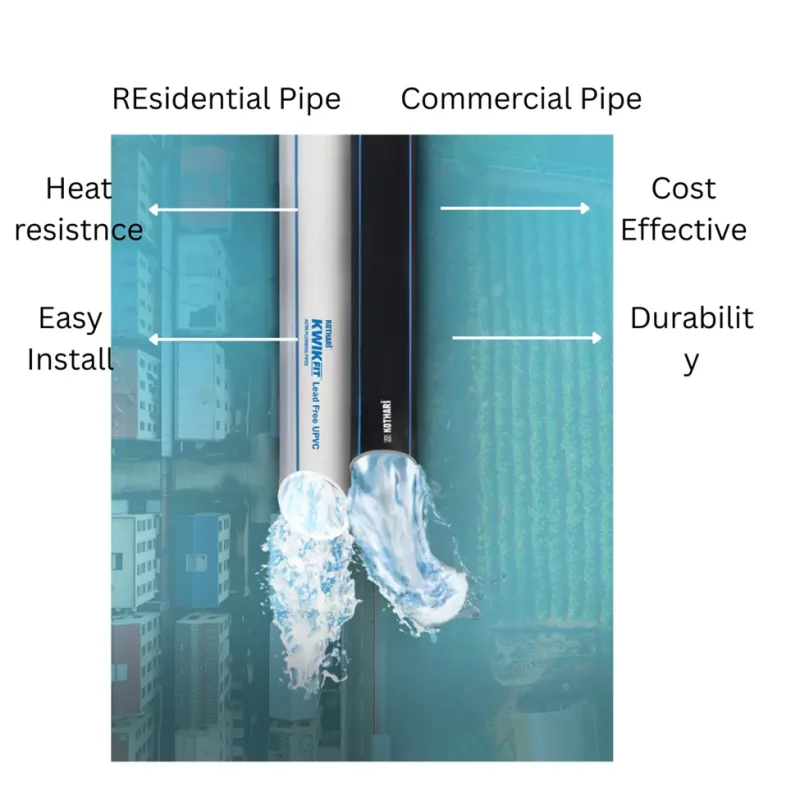
- Heat resistance: These durable CPVC pipes can withstand water temperatures up to 93°C.
- Easy installation: CPVC pipes are lightweight, making them easier to install, which reduces installation costs.
- Consistency: CPVC is highly efficient in commercial spaces, which provides a consistent hot water supply in busy environments.
2. UPVC Pipes
Imagine you turn on your kitchen tap, and rusty red water comes out of your sink. You should have chosen good pipes for plumbing.
Residential use:
UPVC (Unplasticized Polyvinyl Chloride) pipes are rigid and resistant to corrosion. Therefore, they are a good choice for cold water supply and drainage systems. Builders commonly use these UPVC pipes in residential and commercial plumbing systems due to their durability and affordability.
Commercial use:
UPVC pipes are also widely used in commercial plumbing systems, particularly in cold water distribution and drainage systems. As a result, large-scale buildings like malls, factories, and hospitals benefit from UPVC’s low cost and durability.
Advantages:
- Cost-effective: They are more affordable than many other pipe materials, making them ideal for residential properties.
- Durability: These pipes can endure the test of time, making them perfect for systems that don’t need to handle high temperatures or high pressure.
- Resistant: UPVC pipes are resistant to many industrial chemicals, making them suitable for drainage and waste disposal in commercial settings.
3. HDPE Pipes
HDPE (High-Density Polyethylene) pipes are highly flexible and durable, making them a strong contender for underground plumbing systems and sewage systems. Due to their strength and resistance to various chemicals, HDPE pipes are commonly used in residential and commercial projects that involve underground installations.
Residential use:
In residential areas, builders typically install HDPE pipes for underground plumbing systems, especially where the landscape is uneven or added pipe flexibility is needed.
Commercial use:
On a larger scale, commercial projects also rely on HDPE pipes for underground installations such as water distribution networks and sewage systems.
Advantages:
- Flexibility: HDPE pipes are highly flexible, allowing them to adapt to different layouts.
- Leak-proof: The fusion welding method joins HDPE pipes securely, keeping the system leak-proof.
- UV resistance: These pipes have UV resistance that protects their pressure- and temperature-bearing capabilities from damage caused by prolonged exposure to sunlight.
Conclusion
With a thoughtful selection of plumbing pipe for residential or commercial buildings, ensure durability, efficiency and cost effectiveness. Kothari Pipes is a CPVC and UPVC pipe manufacturer in India backed by years of expertise, ensuring that your plumbing system performs efficiently and lasts for years.
Kothari Pipes are ISO-certified, ensuring the highest manufacturing standards and the reliability you can count on. Kothari’s products are available across India, ensuring timely delivery and expert consultation. If you’re ready to select the best plumbing pipes for your next project, contact Kothari Pipes today.
FAQs
1. What’s the difference between CPVC and UPVC pipes?
CPVC is for hot water systems, while UPVC is for cold water and drainage. CPVC can withstand higher temperatures.
2. What is the lifespan of HDPE pipes?
HDPE pipes last over 50 years when properly installed, making them ideal for underground water supply and sewage systems.
3. Are there eco-friendly options for plumbing pipes?
Yes, both UPVC and HDPE pipes are eco-friendly and recyclable, offering long-lasting, sustainable plumbing solutions.
4. What are the best pipes for plumbing in India?
The best pipes for plumbing in India depend on the application — CPVC pipes are ideal for hot water lines, UPVC pipes work well for cold water and drainage, and HDPE pipes are best suited for underground and large-scale installations.
5. Is CPVC pipe safe for drinking water?
Yes, CPVC pipes that meet IS 15778 standards and are certified lead-free are safe for drinking water. Learn more in our detailed guide on CPVC pipe safety and certification.
6. How do I choose the right pipe for my building?
Consider your building type (residential or commercial), water temperature needs (hot or cold), and installation location (above ground or underground). CPVC, UPVC, and HDPE each suit different scenarios, as outlined above.