

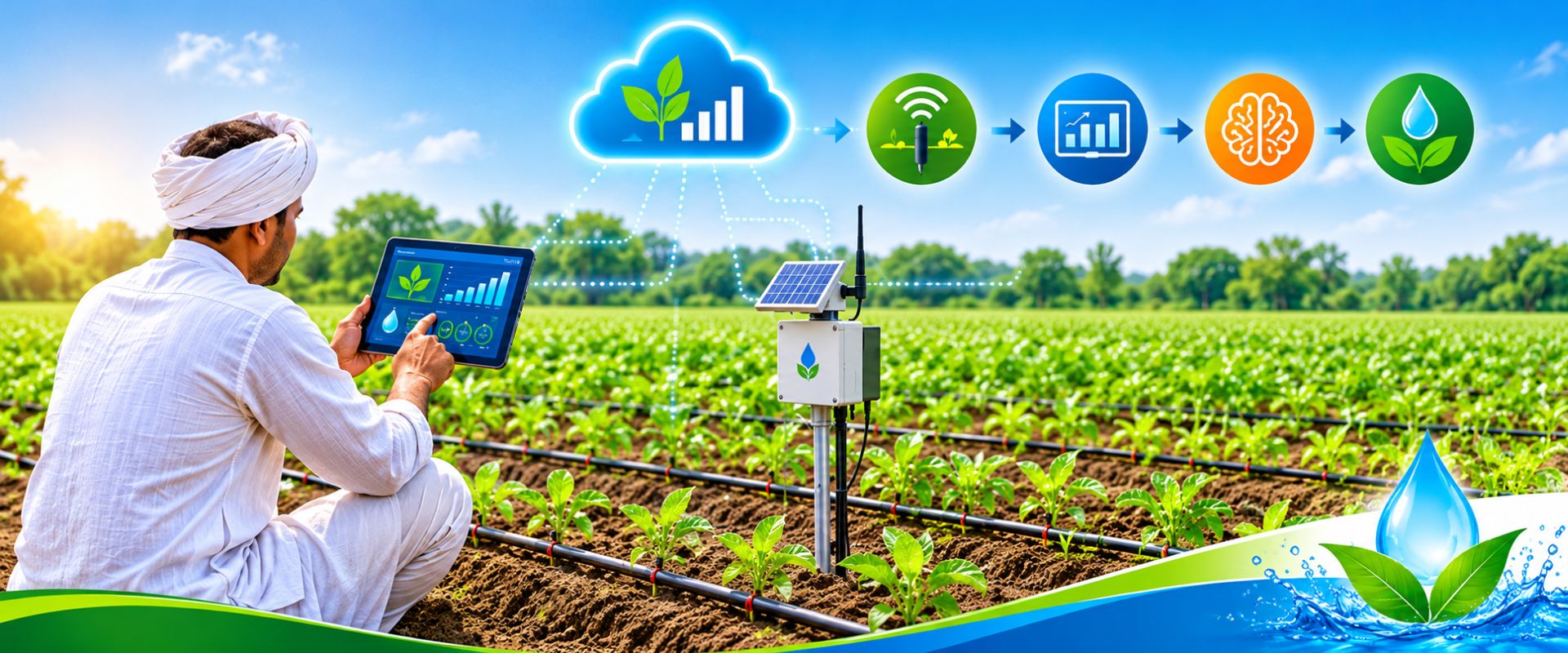
India’s next agricultural transformation will not be driven by machines alone. It will be driven by data, automation and intelligent water and nutrient management. A smart irrigation system is how that shift reaches the field.
The Next Green Revolution May Begin in Data, Not in the Field
The previous major transformation in agriculture had a visible face. It was the seed. Then came chemical fertilisers, irrigation infrastructure, tractors, harvesters and improved farm machinery. The Green Revolution transformed India from a food-deficit nation into one of the world’s major food-producing economies.
Today, agriculture is approaching another defining transition. This time, the most important resource may not be seed, machinery or even additional irrigation infrastructure. It may be information.
Consider the questions that decide every farming season:
- How much moisture is present in the soil?
- How much water will the crop require over the next 24–48 hours?
- Is rainfall expected?
- Is the crop under heat stress?
- Is nitrogen deficiency developing?
- How much fertilizer should the crop receive, and in what concentration?
- Where is groundwater declining?
How Smart Technologies Answer These Questions
Smart technologies such as sensors, the Internet of Things (IoT), cloud platforms, satellite imagery and remote monitoring are beginning to answer these questions. For India, the implications are enormous. According to government data, agriculture and allied sectors account for approximately 46.1% of India’s workforce, while contributing around 18% of Gross Value Added (GVA) in 2023–24. This highlights their vital role in the country’s economy and livelihoods.
At the same time, agriculture remains the world’s largest user of freshwater. According to the Food and Agriculture Organization (FAO), agriculture accounts for approximately 72% of global freshwater withdrawals, while around 1.2 billion people live in agricultural areas facing very high or high water constraints. FAO also estimates that global food, feed and fibre production will need to rise substantially by 2050, increasing pressure on already limited freshwater resources.
This is where automation and irrigation converge. The real value of technology will not be that a farmer can read a report. Instead, its real value will emerge when a connected system measures what the crop actually needs and delivers exactly that, with every drop of water. This is the beginning of intelligent agriculture.
Why Irrigation and Fertigation Matter So Much for India
India’s agricultural challenge is not simply to increase production. The country must simultaneously increase productivity, protect natural resources and improve water-use efficiency.
Government data show that irrigation coverage has expanded considerably. According to the Economic Survey 2024–25, irrigation coverage increased from 49.3% of Gross Cropped Area in 2015–16 to around 55% in 2020–21, while irrigation intensity increased from 144.2% to 154.5% during the same period.
The expansion of irrigation is important. But another question is even more important: how much water and nutrients does it take to produce one unit of agricultural output? That is where efficiency becomes critical.
India’s Per Drop More Crop (PDMC) programme promotes drip and sprinkler irrigation to improve water-use efficiency at the farm level. Government data show that micro-irrigation coverage under PDMC reached 96.97 lakh hectares by March 2025. By June 2026, coverage had increased to approximately 110.92 lakh hectares, while the government allocated around ₹6,587 crore for PMKSY in 2026–27.
This represents an important policy evolution. In fact, India has spent the last decade building the physical infrastructure required for “More Crop per Drop.” However, the next phase should be “The Right Drop at the Right Time.” Drip irrigation can deliver water precisely. Automation can also decide when, how much and in what nutrient concentration to deliver that water.
From Drip Irrigation to Intelligent Irrigation
Drip irrigation transformed the physical delivery of water. But a drip system operated on a fixed schedule is not necessarily a precision irrigation system.
Smart Irrigation and Fertigation Can Combine
- Soil moisture
- Weather forecast
- Crop growth stage
- Evapotranspiration
- Rainfall
- Irrigation history
- Nutrient concentration (EC)
- Water pH
- Groundwater conditions
Consider two farms growing the same crop. One has sandy soil; the other has clay-rich soil. Their water-holding capacities are different. Now assume one farm received 18 mm of rainfall during the previous three days while the other received only 4 mm. Therefore, giving both farms exactly the same irrigation and fertiliser schedule would not be scientifically optimal.
As a result, irrigation and fertigation make a fundamental shift: they move from clock-based management to condition-based management. This is the idea behind sensor-based irrigation.
How an Automated Farm Works: Sense, Measure, Decide, Act
Every automated irrigation system, from a simple controller to a fully connected fertigation machine, follows the same basic logic:
Sense → Measure → Decide → Act
- Sense: Sensors collect information from the field and from the water line.
- Measure: The system tracks key values such as EC (nutrient concentration) and pH continuously.
- Decide: The controller compares the live readings with the target set for the crop.
- Act: Pumps and injection systems correct the dosing automatically, and the system records every cycle.
Overall, this is the fundamental difference between conventional manual farming and emerging automation-enabled agriculture.
Meet NutriJet: Kothari Irrigation’s Smart IoT Fertigation System
Kothari Irrigation’s NutriJet Fertigation Machine brings precision agriculture and real-time automation together in a single IoT-enabled system. Rather than fertigating on a fixed schedule, it injects fertilizer with every single drop of water, continuously measuring EC and pH to maintain the exact nutrient concentration matched to specific crop and soil needs.
Growers can monitor and control the entire system remotely, from anywhere in the world, through its mobile and cloud-based platform. Automated report generation also keeps a complete record of every fertigation cycle, without manual logging.
What Makes NutriJet Stand Out
- IoT and cloud-based real-time monitoring
- Remote mobile control from anywhere
- Accurate EC and pH nutrient control
- Automated fertigation report generation
- Expandable plug-and-play design, available in wired and wireless models
- Fertiliser injection from 300 to 1200 lph, with no pressure loss
- Advanced injection pump system with multiple tank selection
Because the machine is expandable, the system can scale as operations grow, rather than needing replacement. A grower can start with a few plots and extend the same installation as the farm expands.
IoT-Enabled System | Cloud-Based Monitoring | Remote Mobile Control | Real-Time EC Monitoring | Real-Time pH Monitoring | Automated Reporting | Plug-and-Play Design | Wired / Wireless Models | Multiple Tank Selection
Not fertigation by the clock, but fertigation by the crop’s actual need.
Choosing a machine for your farm? Read our fertigation machine buyer’s guide. New to the topic?
Why Data Records Matter
No smart system can be better than the data on which it operates. This is why India’s Digital Agriculture Mission is strategically important. The Union Cabinet approved the mission in September 2024 with a total outlay of approximately ₹2,817 crore, as described by the Press Information Bureau. Its architecture includes AgriStack, the Krishi Decision Support System and a Comprehensive Soil Fertility and Profile Map, among other components.
AgriStack centres on key digital datasets, including the Farmers Registry, geo-referenced village maps and the Crop Sown Registry. Government data available in August 2026 indicate that India had created more than 10.31 crore Farmer IDs. The Digital Crop Survey has also significantly expanded field-level visibility. During Kharif 2025, the system covered more than 28.5 crore plots across 604 districts, according to government information.
India is moving from simply knowing “How many hectares of rice does a district grow?” towards being able to identify “Which crop does each agricultural plot grow?”
Similarly, the same principle applies at the farm level. A machine like NutriJet, which records every fertigation cycle automatically, creates a reliable history of what the farmer applied, when and how much. Over time, this record becomes the foundation for better decisions, season after season.
Conclusion: From Farm to Cloud, and Back to the Farm
The journey from farm to cloud is not about replacing the farmer. It is about giving the farmer better control at the right moment. Sensors can observe, platforms can connect, and machines like NutriJet can act, with the right amount of water and nutrients, at the right time.
A smart irrigation system makes this practical. India has already built a strong foundation, with expanding irrigation, growing micro-irrigation coverage and a rapidly developing digital agriculture ecosystem. The next step is to make this infrastructure intelligent. When data, automation and water management work together, “More Crop per Drop” becomes “The Right Drop at the Right Time.”
The next Green Revolution may begin in data, but the field will prove it.
Ready to make your irrigation and fertigation smarter? Contact the Kothari Group team to find the right setup for your farm. You can also explore our drip irrigation system range and our guide to advanced drip irrigation techniques.
Frequently Asked Questions
What is a smart irrigation system?
A smart irrigation system uses sensors, automation and often cloud software to decide when and how much to irrigate. Instead of following a fixed clock, it responds to conditions such as soil moisture, weather and crop stage.
How does IoT-based irrigation work?
Sensors collect data from the field and the water line, a controller compares it with the target set for the crop, and pumps or injection systems adjust automatically. The system stores the data on a cloud platform, so the farmer can monitor it remotely.
What is EC and pH monitoring in fertigation?
EC measures nutrient concentration in the water, and pH measures its acidity. Tracking both lets a fertigation system keep the nutrient mix at the target set for the crop.
Can you control a fertigation system remotely?
Yes, with the right system. You can monitor and control Kothari’s NutriJet fertigation machine through a mobile and cloud-based platform.
How does automation improve fertigation?
Automation moves fertigation from a fixed schedule to the crop’s actual need. It also records every cycle automatically, which builds a reliable history of what the farmer applied and when.